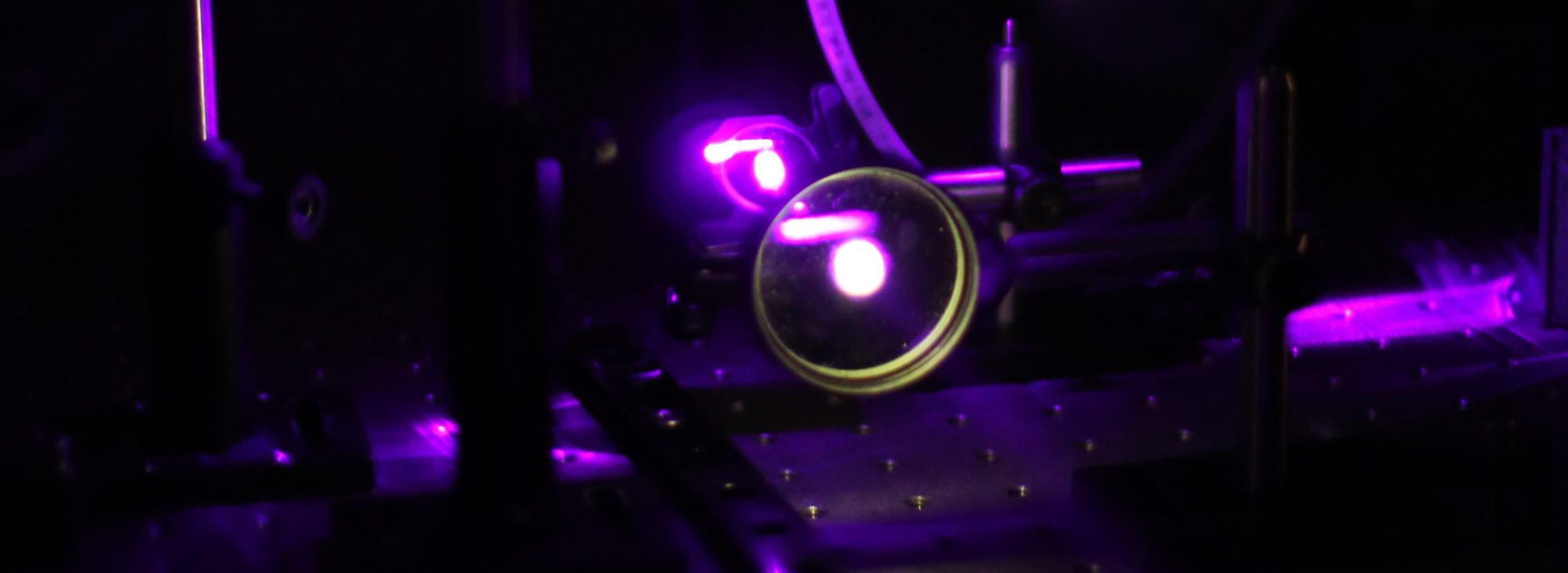
Laser Diagnostics
Reliable, accurate and detailed measurements of properties such as temperature and density are required to understand many of the complex phenomena observed in fluid flows and plasmas. The application and development of laser based diagnostics are often required because they are inherently non-intrusive and are capable of high spatial and temporal resolution. Our group has developed and applied new techniques that include filtered Rayleigh, Raman and Thomson scattering, as well as non-linear optical techniques such as coherent Rayleigh scattering and pre-dissociated laser induced thermal acoustics for measurements of temperature and density in gases and plasmas. Some of these techniques have been coupled with an atomic dispersion filter developed in our group to allow frequency dispersion of the scattered light. To measure velocity, the RELIEF and PHANTOM techniques have been used for measurements in air and water respectively. We have also developed new laser systems that are specifically designed for some of the techniques outlined above. These include a MHz pulse burst laser system which when coupled with a MHz rate framing camera can be used for rapid imaging of flow structures in hypersonic flows. A high power tuneable Ti:Sapphire laser has been built for filtered Rayleigh and Raman scattering measurements in gases and plasmas.
Rotational Raman Imaging
Rotational Raman imaging is motivated by an effort to capture spatially resolved measurements of temperature and density in complex fluid environments, such as flames or reactive flowfields. By spectrally resolving the rotational Raman spectra, information of Boltzmann fraction may be obtained for individual species…and hence, species selective, spatially resolved measurements may be made in harsh environments. The ultraviolet laser is paired with two different styles of spectral filter in order to achieve these measurements.
The Measurement of Unsteady Flow Phenomena by Flow Tagging
(Sponsored by the National Science Foundation)
Newly developed capabilities for writing lines and patterns into both air and water are being applied to the study of fundamental properties of turbulence and unsteady flows. These approaches permit us to capture instantaneous spatial images of turbulent structure which can be analyzed to determine the energy spectrum, intermittency, and velocity structure functions. Details can be resolved down to a few micrometers, which means that the full range of scale from the inertial range to the dissipation range can be captured.
Development of Filtered Rayleigh Scattering for Accurate Measurement of Gas Temperature and Velocity
(Sponsored by NASA/Langley)
This project examines the possibility of using the new Filtered Rayleigh Scattering approach to accurately measure velocity, as well as temperature and density, in a high speed flow. This is accomplished by using a very sharp cut-off molecular filter placed in front of the camera, together with a very narrow linewidth laser. The light scattered from the flow field is shifted in frequency by the Doppler effect and broadened in frequency by the thermal motion of molecules. When the very narrow linewidth laser is tuned in frequency so that the scattered light is partially cut-off by the sharp cut-off molecular filter, the velocity, temperature, and density can be determined. (Continued, with images)
Coherent Rayleigh Scattering
Coherent Rayleigh Scattering (CRS) has recently been developed for measurements of temperature in neutral and weakly ionized gases. This new non-linear optical technique which has been developed in collaboration with J. Grinstead (NIST) is suited to measurements in luminous environments or where optical access is limited. It can be considered to be the non-linear analog of spontaneous Rayleigh scattering, but because it is a phase matched process the signal strength can be orders of magnitude stronger the spontaneous process. We have studied the scattered lineshape both experimentally and theoretically, and have used these results to measure translational temperature in a number of glow discharges.
Predissociated Laser-Induced Thermal Gratings
We have developed a variant of the laser induced thermal acoustic (LITA) method for measuring single laser pulse temperatures in air flows. This technique creates a periodic density perturbation in air, which decays both by thermal and acoustic (sound) modes over hundreds of nanoseconds. Bragg scattering from the grating by another laser is used to measure the acoustic frequency which can be related to the temperature. We have used this technique to measure temperature at the exit of supersonic nozzle and it has been an important diagnostic for the development of the radiatively driven wind tunnel.