Plasma Rampart Program
(Sponsored by the U.S. Air Force Office of Scientific Research)
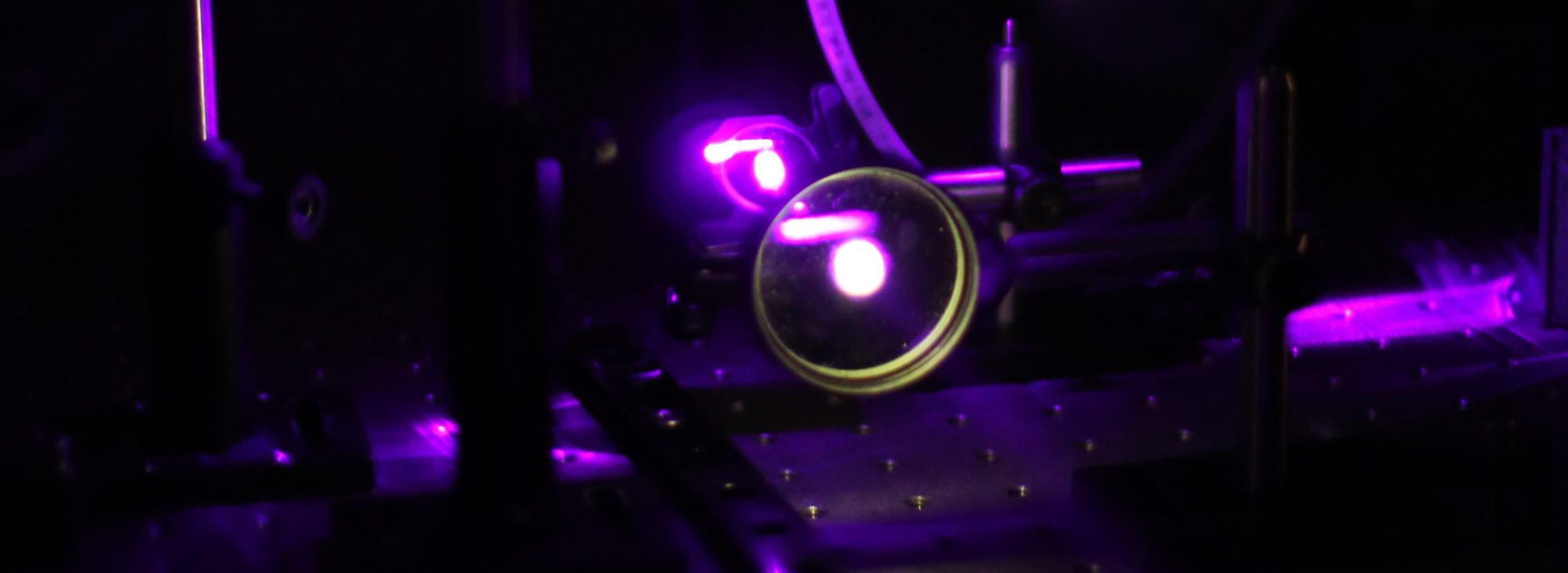
Metastable molecules play an important role in low temperature plasmas. These molecules can store energy in their excited states and can dominate both electron production and lost mechanisms at low temperatures. This research program explores the possibility of controlling metastable state populations with lasers to study the role that they play in plasma dynamics. This understanding may reduce the amount of energy required to sustain a plasma. Early experiments suggest that laser-generated metastable molecules can be used to guide plasmas and control arc formation. If the energy required to sustain a plasma in air can be minimized, and if such a plasma can be properly controlled, it may be useful as a method to protect sensitive electronics or other elements from electromagnetic radiation in much the same way that the ionosphere protects the earth from long wavelength electromagnetic radiation.
Shock Propagation and Supersonic Drag in Low Temperature Plasmas
(Sponsored by the U.S. Air Force Office of Scientific Research)
This project is studying the possibility of establishing and controlling low temperature plasmas in front of and around high-speed vehicles. Through heating, a plasma may be used to reduce the drag on a supersonic vehicle, and there are some indications that shock propagation speed is significantly increased in a low temperature plasma. A supersonic plasma facility is being developed as part of this program in order to measure the effects of the plasmas on shock velocity and drag. This program will also study the possibility of controlling low temperature plasmas using magnetic fields and lasers, as well as the development of new plasma diagnostic instrumentation.